AI agents are moving from answering questions to taking actions. But who is controlling those actions?
Artificial intelligence is entering a new phase. We are moving beyond chatbots that simply generate responses into autonomous AI agents capable of interacting with databases, modifying ERP records, sending emails, processing transactions, managing customer relationships, and executing complex business workflows.
This transformation is powerful. It also introduces an entirely new category of security risks.
When an AI agent can access enterprise infrastructure and execute real-world operations, traditional AI safety measures are no longer enough.
Enterprises need something more fundamental: Agentic Security.
And this is where MCP ADMIN becomes essential.
1. The New Security Problem: AI Agents Have Hands Now
Traditional AI applications primarily operate within a conversational environment. They receive input, process information, and generate output.
Agentic AI is fundamentally different.
An AI agent can:
- Read and modify enterprise databases.
- Create, update, and delete ERP records.
- Send emails and messages.
- Access financial and operational systems.
- Execute API requests.
- Trigger automated business workflows.
- Delegate tasks to other AI agents.
Consider a simple scenario.
An employee asks an AI agent:
“Cancel all pending customer orders and issue refunds.”
The agent might have access to an ERP system, payment gateway, and customer database. It could interpret the request, identify relevant records, and execute multiple operations.
But what if the employee did not have permission to authorize refunds?
What if the agent misunderstood the instruction?
What if the request was injected through a malicious document?
What if another agent manipulated the original agent into executing an unauthorized operation?
The problem is no longer just whether an AI model generates a correct answer.
The problem is whether an AI agent should be allowed to execute an action in the first place.
2. Why Traditional Security Is Not Enough
Enterprises already have firewalls, authentication systems, role-based access control, API gateways, and database permissions.
These remain important, but agentic systems introduce additional challenges.
The confused deputy problem
An AI agent may possess credentials that allow it to perform actions on behalf of an organization. A user could potentially manipulate the agent into exercising privileges the user does not personally possess.
Prompt injection
Instructions hidden inside websites, emails, documents, or retrieved knowledge can attempt to manipulate an agent into ignoring its intended objectives.
Excessive autonomy
An agent might execute a sequence of individually legitimate operations that collectively create an unauthorized or damaging outcome.
Lack of accountability
When multiple agents and external tools interact, determining who initiated an operation, what parameters were supplied, and why an action occurred becomes increasingly difficult.
Uncontrolled tool access
Connecting an AI agent to 100 tools should not automatically mean giving it unrestricted access to all 100 capabilities.
These challenges demand a security architecture that operates between AI agents and the systems they control.
3. Introducing Agentic Security
Agentic Security is the practice of governing, monitoring, restricting, and auditing the actions performed by autonomous AI systems.
It requires multiple layers of protection:
- Identity and access control: Who is the agent, and what is it allowed to access?
- Tool-level governance: Which operations can the agent execute?
- Policy enforcement: Which actions require additional authorization?
- Human oversight: When should a human intervene?
- Auditability: Can every important operation be traced and investigated?
The objective is not to prevent AI agents from being autonomous.
It is to make their autonomy controlled, observable, and accountable.
4. MCP ADMIN: The Governance Layer for Agentic AI
MCP ADMIN provides a centralized control plane for managing MCP-connected tools, AI agents, integrations, and enterprise infrastructure.
Rather than allowing every AI agent to connect directly to individual services without centralized governance, MCP ADMIN provides a unified gateway through which tool interactions can be managed.
Its architecture brings several important security capabilities together.
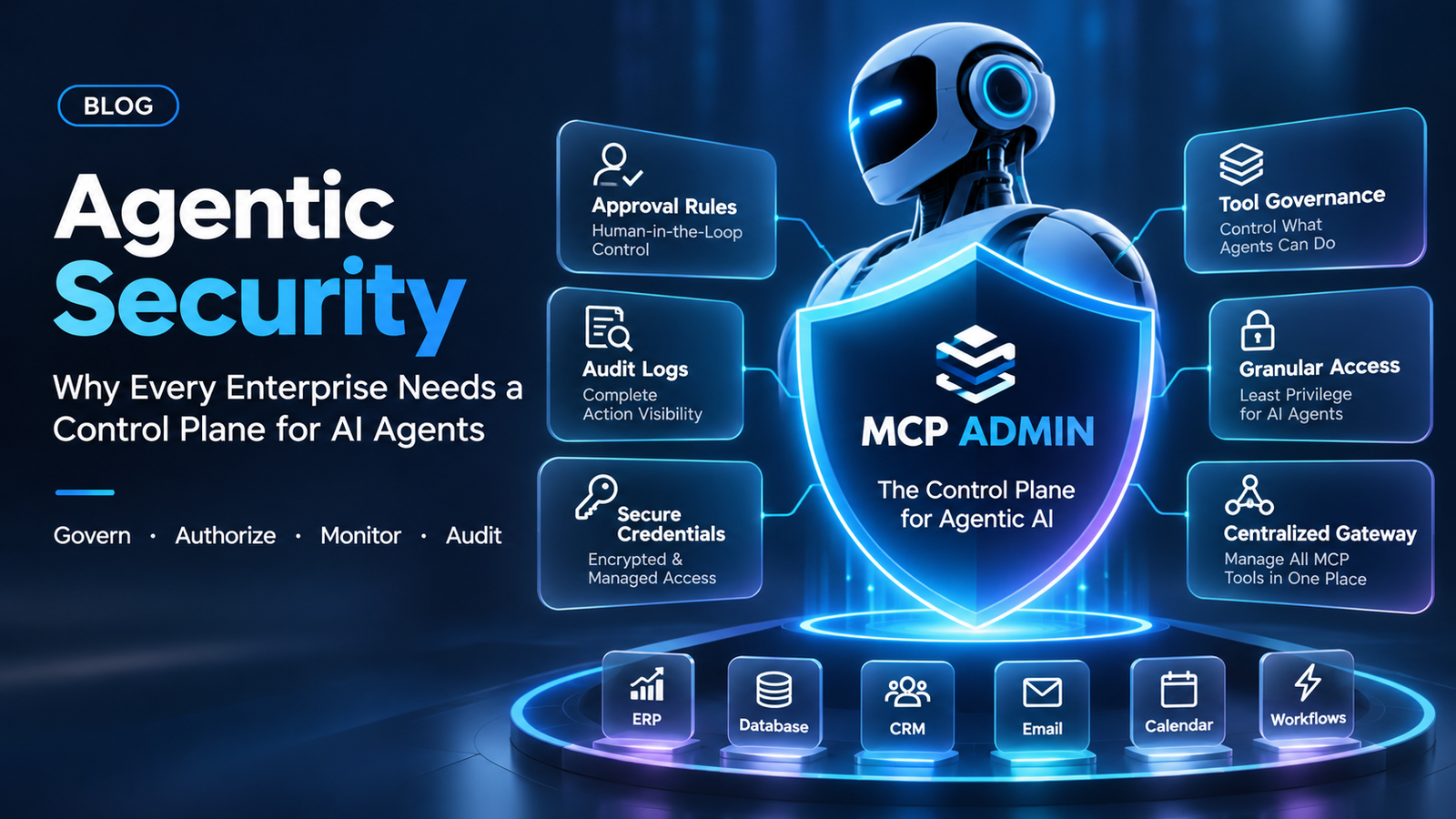
A. Approval Rules: Human-in-the-Loop Security
Not every operation should be executed automatically.
MCP ADMIN provides configurable approval rules that allow administrators to define which tool operations require human authorization.
For example:
- A database read operation can execute normally.
- A database deletion can require administrator approval.
- A refund exceeding a configured threshold can be intercepted.
- A sensitive ERP operation can be held until an authorized person reviews it.
Administrators can configure rules using tool actions, parameters, conditions, and matching values.
When an invocation matches an approval policy, execution is suspended pending authorization.
MCP ADMIN also supports Telegram-based and dashboard-based approval workflows.
This introduces an important security principle:
An AI agent can request an operation without automatically receiving permission to execute it.
B. Audit Logs: Complete Operational Visibility
Security without visibility is incomplete.
Enterprises need to know what their AI agents are doing, which tools they are accessing, and what happens when they execute an operation.
MCP ADMIN provides comprehensive audit logging and real-time SSE telemetry.
Its documented audit architecture captures:
- Incoming HTTP and SSE connections.
- JSON-RPC requests and payloads.
- Tool execution events.
- Parameters supplied to tools.
- Response codes.
- Execution latency.
- Errors and stack traces.
This provides administrators with an operational record of agent activity.
Instead of treating AI execution as a black box, organizations gain the ability to investigate and understand tool interactions.
C. Centralized MCP Gateway
Managing multiple MCP servers independently creates operational complexity.
Each integration introduces its own endpoint, configuration, authentication requirements, and tool definitions.
MCP ADMIN provides a Master MCP Gateway that aggregates tools from multiple integrations and remote MCP servers.
This creates a centralized point for managing access to enterprise capabilities.
Organizations can connect AI assistants, IDEs, custom agents, and enterprise applications through a unified gateway.
D. Granular Tool Access
An integration may expose dozens of operations, but an agent rarely needs all of them.
For example, a CRM agent might need:
- Search customers.
- Retrieve customer information.
- Create leads.
It may not need:
- Delete customers.
- Export the entire customer database.
- Modify administrative settings.
MCP ADMIN supports selective tool attachment and capability binding, allowing teams to expose only the operations required by an agent.
This supports the principle of least privilege.
E. Secure Credential Management
AI agents should not need direct access to raw API keys, database passwords, or service credentials.
MCP ADMIN’s Sandbox Vault provides encrypted credential storage and server-side proxy injection.
Credentials are injected when the gateway processes an authorized tool request rather than being exposed directly to the model’s context window.
This reduces credential exposure and centralizes sensitive configuration management.
5. A Real-World Example: Securing an AI Finance Agent
Imagine an enterprise deploying an AI finance agent connected to:
- ERPNext.
- A payment gateway.
- A vendor management system.
- A financial reporting database.
The agent can retrieve invoices, verify vendor information, prepare payments, and submit payment operations.
Without a governance layer, the agent’s ability to execute actions becomes a major operational concern.
With MCP ADMIN, the workflow can be designed differently.
Scenario: An AI agent attempts to submit a ₹5,00,000 vendor payment.
- The finance agent invokes the payment submission tool.
- MCP ADMIN receives the tool request through its gateway.
- The configured approval policy evaluates the operation.
- The request is suspended if it matches the approval conditions.
- An authorized administrator reviews the operation.
- The administrator approves or rejects it.
- The execution result is returned to the agent.
- The operation is recorded in the audit trail.
The AI agent remains capable of handling the workflow, but the organization retains control over sensitive financial operations.
6. Agentic Security Is Becoming an Enterprise Requirement
As organizations deploy more autonomous agents, security cannot remain an afterthought.
Consider the future enterprise environment:
- Multiple AI agents working across departments.
- Agents communicating with other agents.
- Hundreds of connected enterprise tools.
- Automated financial and operational workflows.
- AI systems operating continuously.
- External AI models accessing internal infrastructure.
Without centralized governance, every new agent and integration potentially increases the organization’s attack surface.
Enterprises need a consistent way to control what agents can do, when they can do it, and how their actions are recorded.
MCP ADMIN addresses this requirement by bringing gateway management, granular tool access, approval policies, encrypted credential handling, and audit visibility into one platform.
7. The Future: From AI Automation to Governed AI Operations
The next generation of enterprise software will not simply be about integrating AI into existing applications.
It will be about creating autonomous systems that can safely operate those applications.
Organizations that deploy AI without governance risk creating powerful but difficult-to-control operational environments.
Organizations that build governance into their AI architecture from the beginning will be better positioned to scale automation responsibly.
Agentic AI needs more than intelligence.
It needs identity, permissions, policies, oversight, and accountability.
MCP ADMIN provides the governance infrastructure to make that possible.
Conclusion
The question enterprises should be asking is no longer:
“How many tools can our AI agents access?”
It should be:
“How do we ensure every action taken by our AI agents is authorized, controlled, and auditable?”
That is the foundation of Agentic Security.
And as autonomous AI becomes an integral part of enterprise operations, a centralized governance layer such as MCP ADMIN is not merely a convenient addition.
It is becoming essential infrastructure for enterprise AI.
MCP ADMIN — Govern Your AI. Control Every Action.
Explore MCP ADMIN: https://mcpadmin.cloud/