🚀 Claude + MCP: Building AI Agents With External Tools
Learn how to transform Claude from a conversational AI into a production-ready agent that can use tools, access knowledge, search the web, remember context and execute real-world workflows.
AI agents are moving from simple text generation to systems that can reason, retrieve information, call tools, access business systems and execute workflows. Claude provides the reasoning layer, while the Model Context Protocol (MCP) provides a standardized way to connect that intelligence to external capabilities.
In this guide, we’ll explore how Claude + MCP works, why external tools matter, how memory and knowledge improve agent performance, and how a control plane such as MCP Admin can organize tools, integrations, automations and governance.
🧠 Claude provides reasoning. MCP connects that reasoning to the tools and context needed to get work done.
🤖 What Is Claude + MCP?
Claude is an AI model built for language understanding, reasoning and generation. MCP is an open protocol for connecting compatible AI applications with external tools and context.
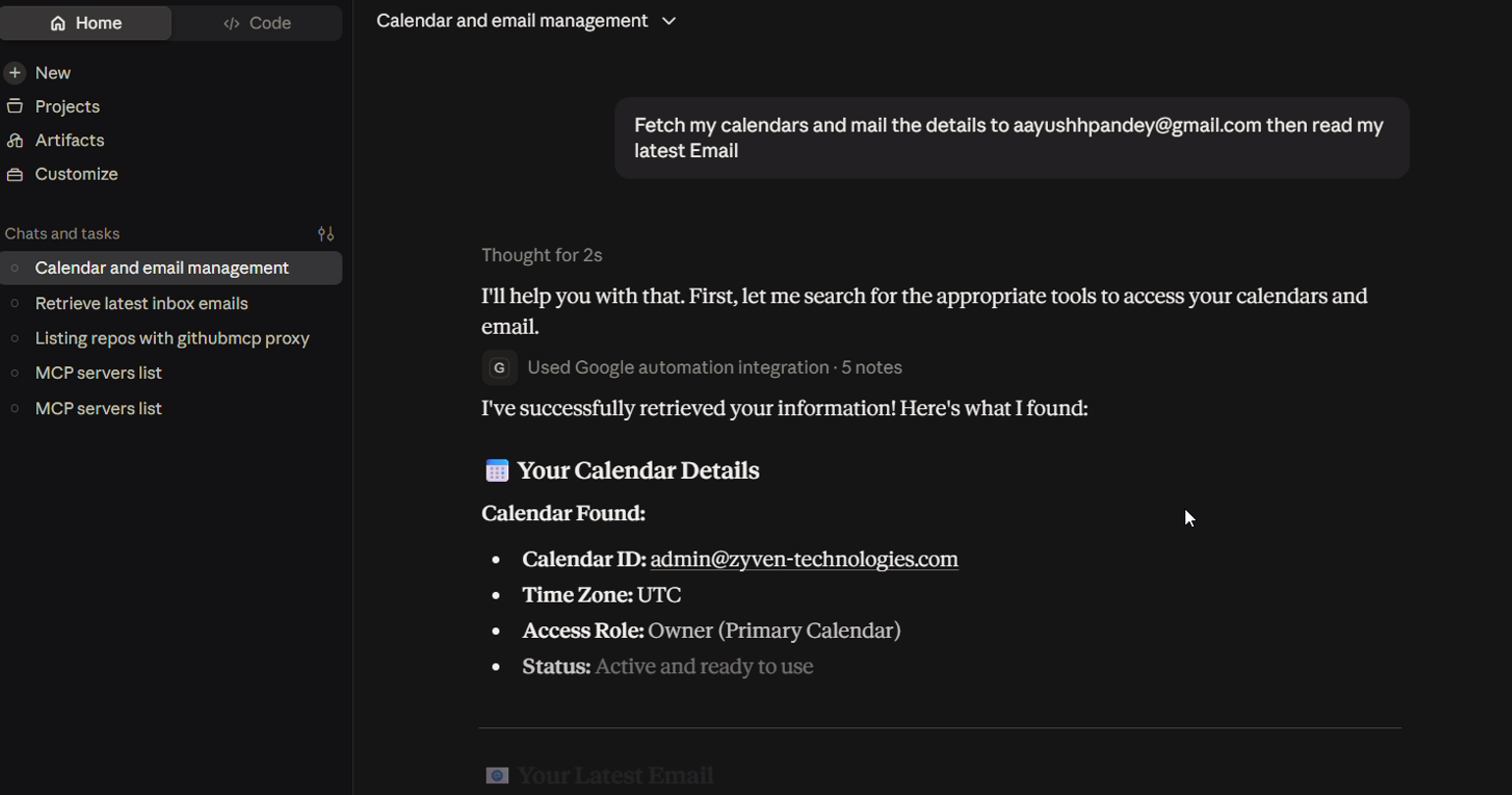
Put them together and Claude can move beyond answering questions. Depending on the connected MCP servers and permissions, it can discover capabilities and use external tools to retrieve information or perform actions.
USER
  ↓
CLAUDE
  ↓
MCP SERVER / GATEWAY
  ↓
TOOLS • KNOWLEDGE • MEMORY • WEB • APIS
  ↓
RESULT
  ↓
CLAUDE
  ↓
ANSWER OR ACTION
🔌 Why Give Claude External Tools?
A language model cannot automatically know your latest CRM record, internal documentation, current market news or the state of your production systems. External tools bridge the gap between model knowledge and real-world information.
| Capability | What it adds |
|---|---|
| 📚 Knowledge | Private company information and documentation |
| 🌐 Web Search | Current public information |
| 🔌 Tools & APIs | Access to business and developer systems |
| 🧠 Memory | Context that can persist between sessions |
| ⚡ Automations | Deterministic multi-step execution |
🧩 What Is the Model Context Protocol?
The Model Context Protocol (MCP) provides a standardized interface for AI applications to interact with external capabilities. Instead of building a separate integration architecture for every AI client, MCP servers can expose reusable tools and resources.
This creates a useful separation of concerns: the model handles reasoning while the MCP layer handles access to external capabilities.
🏗️ The Architecture Behind a Claude MCP Agent
CLAUDE / AI CLIENT
       │
       ▼
   MCP GATEWAY
       │
 ┌─────┼──────────────┐
 ▼     ▼              ▼
TOOLS KNOWLEDGE      MEMORY
 │     │              │
 ▼     ▼              ▼
APIs  DOCUMENTS     STATE
       │
       ▼
   WEB SEARCH
       │
       ▼
AUTOMATIONS / ACTIONS
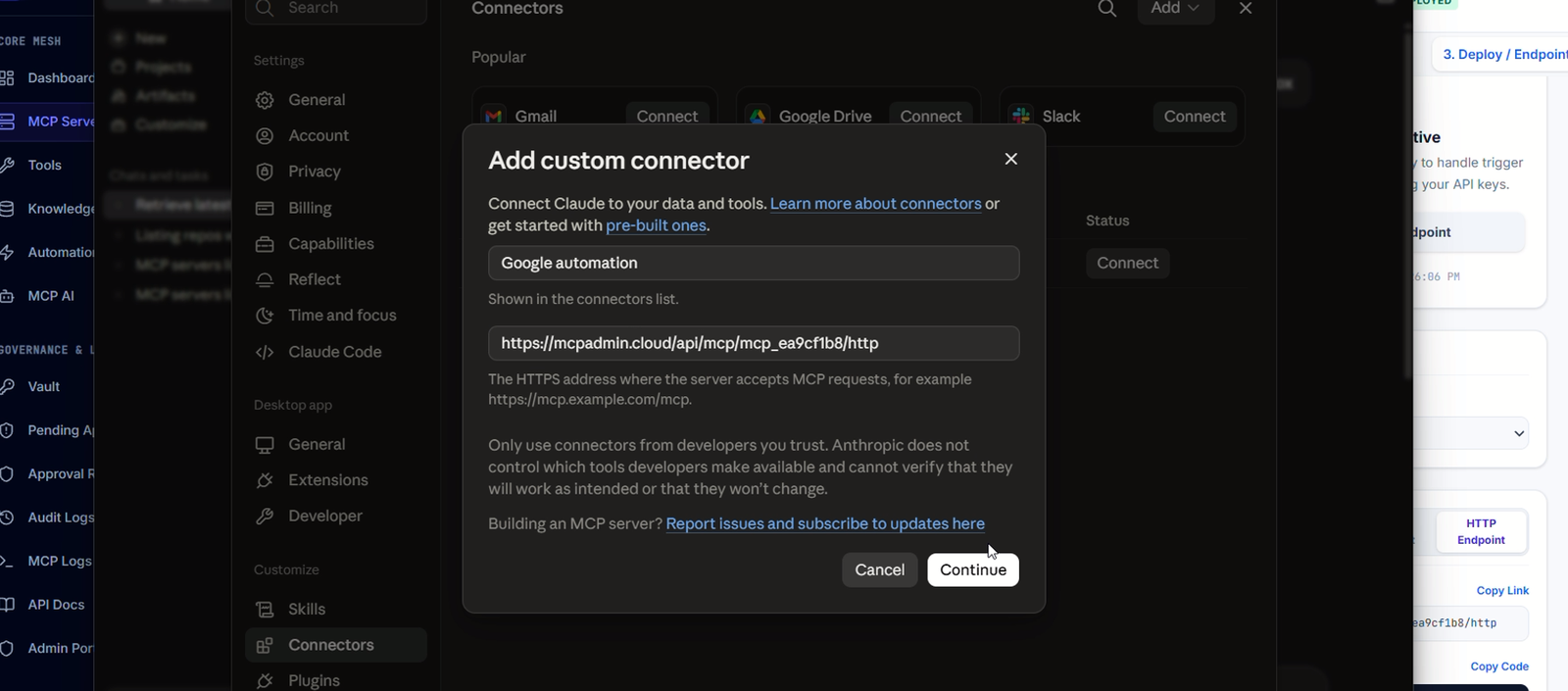
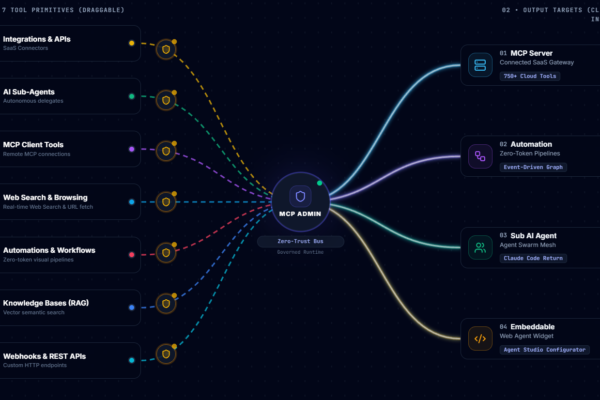
A gateway becomes particularly valuable when an agent needs access to multiple MCP servers and integrations. Instead of configuring every backend separately, the client can work through a centralized infrastructure layer.
📚 Give Claude Access to Your Knowledge Base
Claude’s general knowledge is not a substitute for your private organizational knowledge. A knowledge base can provide context from product documentation, policies, research, internal procedures and other approved sources.
With semantic retrieval, the system can find relevant information by meaning instead of relying only on exact keyword matches. This pattern is useful for customer support, internal assistants, research agents and enterprise copilots.
💡 Example
User: “What is our enterprise escalation process?”
The agent retrieves the relevant internal documentation and uses it as context before generating the answer.
🌐 Add Web Search for Current Information
Private knowledge tells Claude what your organization knows. Web search can provide information that changes over time.
- 📰 Current news and announcements
- 📈 Market and industry developments
- 🏢 Competitor research
- 🔬 Recent technical information
- 🔗 Information retrieved from URLs
A hybrid agent can combine internal knowledge + external web information + live business data when the task requires all three.
🔌 Connect Claude to External Business Tools
Tools are where an AI agent becomes operational. Depending on the integrations available to the MCP environment, Claude can work with systems such as GitHub, databases, project management tools, communication platforms, content systems and custom APIs.
For example, a development agent might inspect a GitHub repository, create an issue and summarize the change. A content agent might research a topic and then send approved content to WordPress. The model decides what capability is needed; the connected tool performs the operation.
🧠 Persistent Memory for Claude Agents
A conversation context is temporary. Persistent agent memory can preserve selected information across sessions, such as preferences, project state, previous decisions and long-running workflow context.
- 👤 User preferences
- 📁 Project context
- ✅ Previous decisions
- 🔄 Workflow state
- 🧠 Relevant historical information
Good memory is selective. The objective is to preserve information that is useful later, while applying appropriate access and retention controls.
⚡ Zero-Token Automations
Not every step of an agent workflow requires another LLM decision. When the execution sequence is known, a deterministic automation can perform it directly.
CLAUDE DECIDES
      ↓
RUN AUTOMATION
      ↓
Create Record
      ↓
Update System
      ↓
Send Approved Notification
      ↓
AUDIT RESULT
This separates reasoning from predictable execution. Claude can decide when a workflow should run, while the automation handles the known sequence.
🛡️ Secure Claude Tool Use
Giving an AI agent access to real systems introduces a critical requirement: capability must be paired with governance.
- 👥 RBAC: restrict access to approved capabilities.
- 🧾 JSON-RPC validation: validate structured protocol requests.
- 🛑 Approval policies: require review for sensitive operations.
- 🔑 Secrets management: avoid unnecessary exposure of service credentials.
- 📊 Audit logs: maintain visibility into important execution activity.
🔐 The safest AI agent is not one with fewer capabilities. It is one with clearly defined capabilities and boundaries.
🚦 Human-in-the-Loop Approvals
Some actions should not happen automatically. A production system may require a human to approve destructive database operations, sensitive changes or high-impact business actions.
Claude Requests Action
          ↓
     Policy Check
          ↓
   ┌──────┴──────┐
   │             │
Allowed       Approval
   │             ↓
   │       Human Reviews
   │             ↓
   │       Approve / Reject
   └──────┬──────┘
          ↓
       Execute
This gives organizations a practical balance between autonomous agents and human oversight.
📊 Observe What Your Agent Actually Did
When Claude can execute tools, the output of the model is only part of the story. Teams also need visibility into tool calls, routing, execution and outcomes.
- 🔍 Inspect execution activity
- ⏱️ Investigate latency and failures
- 🧾 Review audit records
- 🛠️ Troubleshoot tool workflows
🖥️ Why Use a Control Plane for Claude + MCP?
One MCP server is manageable. A growing ecosystem of servers, tools and integrations is much harder to operate. A centralized control plane can provide a common layer for server management, tool lifecycle, routing, policies, memory, knowledge and observability.
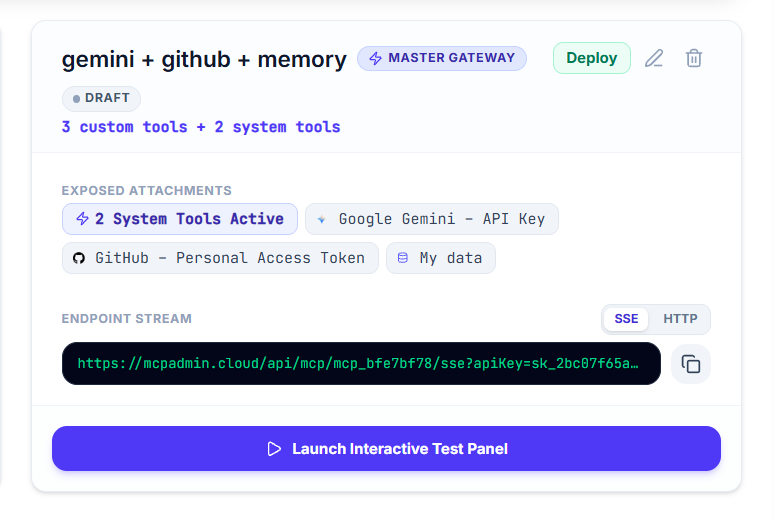
MCP Admin is built around this control-plane model. It brings together agent infrastructure capabilities while treating services such as WordPress, GitHub and AI providers as integrations that can be connected to the wider agent stack.
📝 Example: Claude + MCP + WordPress
Imagine an AI content workflow:
Content Brief
     ↓
Web Research
     ↓
Knowledge Base
     ↓
Claude Generates Article
     ↓
Review / Approval
     ↓
WordPress Integration
     ↓
Create or Update Post
Here, WordPress is simply one external integration. The overall agent workflow combines research, private knowledge, AI reasoning, governance and content execution.
🐙 Example: Claude + MCP + GitHub
A development agent can use a GitHub integration to inspect repositories, search code, work with issues and pull requests, review changes and interact with other approved repository capabilities.
This turns Claude from a coding assistant into an interface that can participate in the software-development workflow.
🏆 Best Practices for Building Claude MCP Agents
- Give agents focused tools. Small, well-defined capabilities are easier to secure and reason about.
- Retrieve relevant context. Do not send every document or record to the model.
- Separate reasoning from execution. Use deterministic workflows where the sequence is already known.
- Protect credentials. Keep secrets in the infrastructure layer rather than exposing them unnecessarily to clients.
- Require approval for high-impact operations.
- Log important execution activity.
- Design for failure. Tools can be unavailable, APIs can fail and data can change.
⚖️ Claude + MCP vs. a Traditional Chatbot
| Capability | Traditional Chatbot | Claude + MCP |
|---|---|---|
| Reasoning | ✅ | ✅ |
| Private knowledge | Limited | ✅ |
| Current web information | Limited | ✅ |
| External tools | Limited | ✅ |
| Persistent context | Usually session-based | ✅ |
| Workflow execution | Limited | ✅ |
| Governance | Application-specific | Centralizable |
❓ Frequently Asked Questions
What is Claude MCP?
Claude MCP refers to using Claude with the Model Context Protocol so the AI application can interact with external tools and context exposed through compatible MCP servers.
Can Claude use external tools?
Yes. When connected to compatible MCP servers, Claude can discover and invoke available tools according to the client’s capabilities and configured permissions.
Can Claude connect to APIs through MCP?
Yes. APIs can be exposed through MCP tools, allowing Claude to interact with approved external services through a standardized agent interface.
Can Claude use persistent memory?
Claude can participate in agent architectures that provide persistent memory through external infrastructure. MCP itself provides the connection mechanism; memory storage and retrieval are supplied by the connected system.
Can Claude search the web with MCP?
Yes, when a web-search capability is exposed through the MCP environment. This lets an agent retrieve current public information when required.
Is MCP only for Claude?
No. MCP is designed as a standardized protocol for compatible AI applications. Claude is one important client environment, but the architecture can support other compatible clients and custom applications.
What is MCP Admin?
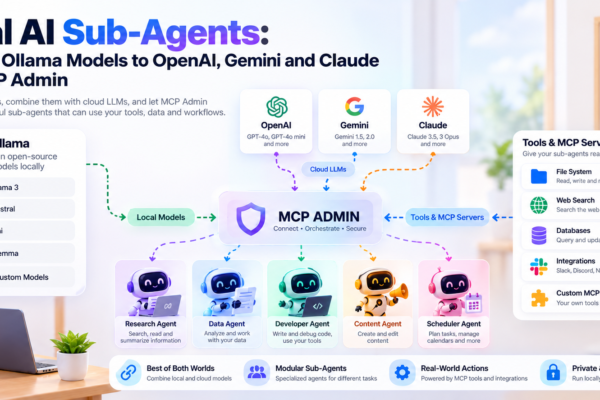
MCP Admin is an agentic infrastructure control plane designed to organize MCP servers, tools, knowledge, memory, web capabilities, automations, approvals, security and observability, while connecting external integrations to AI agents.
🚀 Final Thoughts
Claude is powerful because it can reason about complex tasks. MCP makes that reasoning more useful by connecting Claude to the external systems and context required to complete those tasks.
The result is a new class of software: AI agents that can understand, retrieve, decide and act.
For teams building these systems, the important question is no longer simply which model to use. It is how to provide the right tools, knowledge, memory, integrations, automation and governance around that model.
🧠 Claude + 🔌 MCP + ⚡ Tools + 📚 Knowledge + 🌐 Web + 🧠 Memory = More Capable AI Agents